When choosing a microscope, magnification and resolution usually receive most of the attention.
But for many applications, another specification can be just as important:
Working distance.
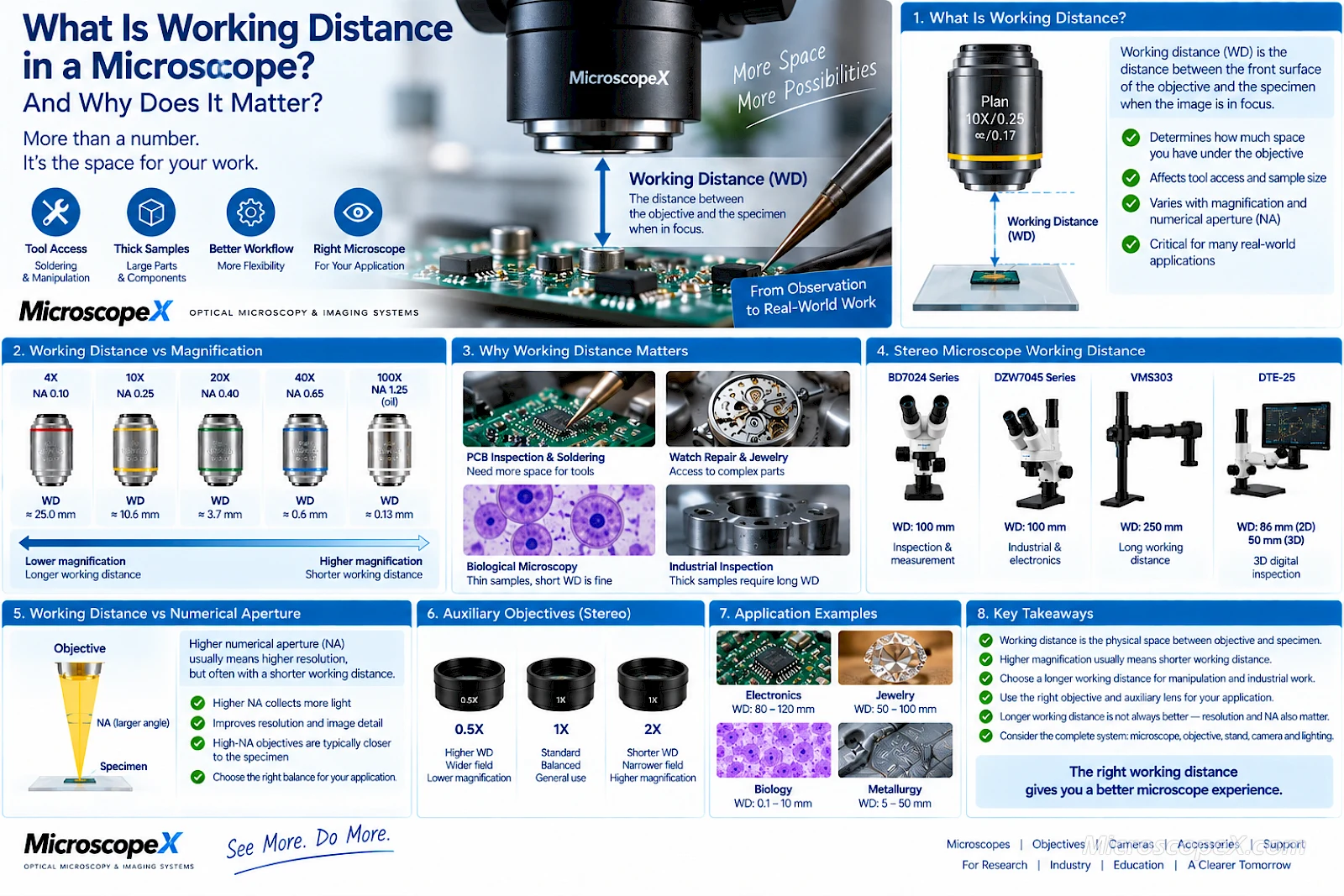
Working distance determines how much physical space exists between the microscope objective and the specimen while the image is in focus.
That space directly affects whether you can:
- Use tweezers
- Position a soldering iron
- Manipulate a specimen
- Inspect a thick component
- Work around a PCB
- Use probes or measuring tools
- Observe samples inside specialized holders
For biological microscopy, a short working distance may be completely normal at high magnification.
For electronics repair or industrial inspection, the same short working distance could make the microscope extremely difficult to use.
The right working distance therefore depends on the application.
This guide explains what microscope working distance means, why it changes with magnification and numerical aperture, and how to choose the correct working distance for stereo, biological and industrial microscopes.
For a general introduction to microscope optics, see Optical Microscope Basics.
What Is Microscope Working Distance?
Working distance, often abbreviated as:
WD
is the distance between the front surface of the microscope objective and the specimen when the specimen is sharply focused.
In simplified form:
Objective
↓
Working Distance
↓
Specimen
This distance may range from:
- A fraction of a millimeter
- Several millimeters
- Tens of millimeters
- More than 100 mm
depending on the microscope design.
Some specialized industrial systems can provide working distances of several hundred millimeters.
Working Distance vs Focal Length
Working distance and focal length are related concepts, but they are not the same thing.
Working Distance
Measures the usable physical space between:
Front of objective → specimen
when focused.
Focal Length
Describes an optical property of the lens system related to how strongly it converges light.
For the microscope user, working distance is usually the more practical specification because it tells you:
How much space do I actually have beneath the objective?
This becomes extremely important when tools or large specimens are involved.
Why Working Distance Matters
A microscope can produce an excellent image and still be poorly suited to your application if the working distance is wrong.
Consider two examples.
Biological Slide
The specimen is:
- Thin
- Flat
- Mounted on glass
- Not manipulated while viewed
A short working distance may be completely acceptable.
PCB Repair
The specimen may have:
- Tall capacitors
- Connectors
- Shielding
- Wires
- Solder joints
and you also need room for:
- Soldering iron
- Hot-air nozzle
- Tweezers
- Probes
In this situation, long working distance becomes essential.
Working Distance at a Glance
| Working Distance | Typical Characteristics | Common Applications |
|---|---|---|
| Very short | High magnification, high NA | High-resolution biological microscopy |
| Short | Fine microscopic structures | Biology, histology |
| Medium | General inspection | Metallurgy, materials analysis |
| Long | More tool and specimen clearance | Stereo microscopy, electronics |
| Very long | Maximum manipulation space | Large parts, industrial repair |
There is no single ideal working distance.
The best value depends on what you need to do underneath the microscope.
Magnification and Working Distance
One of the most important relationships in microscopy is:
Higher magnification usually means shorter working distance.
This is not an absolute rule for every optical design, but it is a very common pattern.
A low-power objective can typically focus farther away from the specimen.
A high-power objective usually needs to be much closer.
Example: Low vs High Magnification
Imagine a biological microscope.
4× Objective
Typically provides:
- Large field of view
- Long working distance
- Easy specimen navigation
40× Objective
Typically provides:
- Smaller field
- Higher resolution
- Shorter working distance
100× Oil Objective
Typically provides:
- Very high magnification
- High numerical aperture
- Extremely short working distance
This is one reason you should always begin biological observation at low magnification.
Why High-Power Objectives Get So Close to the Specimen
High-resolution objectives need to collect light from a relatively wide angular cone.
This often requires the front optical element to be positioned close to the specimen.
As magnification and numerical aperture increase, objective design becomes increasingly demanding.
The result is usually:
Higher resolution
but:
Less physical clearance
This is a fundamental trade-off in many microscope systems.
Numerical Aperture and Working Distance
Numerical aperture, or NA, describes an objective's ability to collect light and resolve fine detail.
Higher NA generally provides:
- Better resolution
- Better light collection
But high-NA objectives often have shorter working distances.
Consider the design challenge.
To capture high-angle rays from the specimen, the objective usually needs to approach the sample more closely.
Therefore:
High NA → often shorter WD
This means objective selection involves balancing:
- Resolution
- Working distance
- Magnification
- Application requirements
Working Distance vs Resolution
Users sometimes assume that long working distance is always better.
It is not.
Increasing working distance can make manipulation easier, but optical designers may need to make trade-offs involving:
- Numerical aperture
- Resolution
- Lens complexity
- Objective size
A high-resolution objective optimized for cellular detail may deliberately use a very short working distance.
An industrial objective may sacrifice some NA to provide more physical clearance.
Neither design is inherently superior.
They solve different problems.
Working Distance in Stereo Microscopes
Stereo microscopes are well known for providing relatively long working distances.
This is one reason they are widely used for:
- Electronics repair
- PCB inspection
- Microsoldering
- Mechanical assembly
- Jewelry
- Watchmaking
- Dissection
- Industrial quality control
Unlike a high-power compound microscope, a stereo microscope is designed to let the operator work directly on the specimen.
Explore Stereo Microscopes for industrial and laboratory systems.
Typical Stereo Microscope Working Distance
A general-purpose stereo microscope may provide working distance around:
80–120 mm
in a standard optical configuration.
Some models provide more.
Specialized systems may provide:
150 mm
200 mm
250 mm
or considerably more.
The exact value depends on:
- Objective
- Zoom system
- Auxiliary lens
- Stand
- Focusing mechanism
Why Long Working Distance Is Important for Electronics
Imagine microsoldering a PCB.
Beneath the microscope you may need to position:
- Soldering iron
- Hot-air nozzle
- Tweezers
- Wire
- Flux syringe
- Probe
At the same time, the board may contain tall components.
With insufficient working distance, the objective becomes an obstacle.
A longer working distance creates a usable workspace rather than merely an observation area.
Working Distance for PCB Inspection
For simple visual inspection, around:
80–100 mm
may already provide comfortable clearance.
For active soldering and rework, additional distance can be valuable.
The ideal value depends on:
- Board size
- Component height
- Tool angle
- Microscope stand
- Operator preference
More working distance can improve freedom of movement.
Working Distance for Microsoldering
Microsoldering places particularly high demands on working distance.
A useful microscope configuration should allow the soldering iron to approach the board without contacting:
- Objective housing
- Ring light
- Camera assembly
This is why many electronics users prefer stereo microscopes with:
- Long WD
- Wide field
- Moderate magnification
rather than extremely high magnification.
Auxiliary Objectives and Working Distance
Stereo microscopes often support auxiliary objectives such as:
- 0.5×
- 0.7×
- 1×
- 1.5×
- 2×
These lenses change more than magnification.
They can also affect:
- Working distance
- Field of view
- Effective magnification
What Does a 0.5× Auxiliary Objective Do?
A 0.5× auxiliary objective generally:
- Reduces magnification
- Increases field of view
- Increases working distance
This combination can be extremely useful for:
- PCB repair
- Large objects
- Assembly
- Tool manipulation
Suppose a stereo microscope normally provides:
7×–45×
Adding a 0.5× objective could produce approximately:
3.5×–22.5×
The lower magnification may actually make the microscope more useful for electronics.
Why a 0.5× Lens Can Be Better for Soldering
More magnification is not always better.
For soldering you often need to see:
- Component
- Nearby pads
- Tool tip
- Surrounding parts
A wide field is helpful.
At the same time, you need room to bring tools under the objective.
A 0.5× auxiliary objective can provide both:
Wider field + longer working distance
which makes it a popular configuration for repair work.
What Does a 2× Auxiliary Objective Do?
A 2× objective generally produces the opposite effect.
It provides:
- Higher magnification
- Smaller field
- Shorter working distance
This can be useful for:
- Fine defect inspection
- Small surface structures
- Detailed observation
but may be less convenient for active manipulation.
Working Distance vs Field of View
Working distance and field of view are often related indirectly through magnification.
Lower magnification generally produces:
- Wider field of view
- Longer working distance
Higher magnification generally produces:
- Narrower field
- Shorter working distance
For many industrial tasks, the lower-magnification combination is more practical.
Example: Industrial Stereo Microscope
The BD7024 Series provides a useful example.
Its standard configurations specify approximately:
100 mm working distance
across multiple eyepiece and objective combinations.
With a 10× eyepiece:
- 10× magnification provides about 20 mm field of view
- 20× provides about 10 mm
- 40× provides about 5 mm
This illustrates a practical relationship:
Higher magnification → smaller visible field
while maintaining a useful industrial working distance.
Super-Long Working Distance Stereo Microscopes
Some industrial applications require substantially more clearance.
For example:
- Large machine parts
- Mold inspection
- Magnetic workpieces
- Surface repair
- Assemblies that cannot fit on a normal microscope stage
For these applications, specialized long-working-distance systems can be used.
Example: 250 mm Working Distance
The VMS303 Industrial Stereo Microscope is designed for large workpieces and provides a maximum working distance of approximately:
250 mm
It also uses a flexible arm and magnetic base.
This type of configuration is useful when the microscope must be brought to the object rather than placing the object on a microscope stage.
Very Long Working Distance Digital Systems
Some digital inspection systems provide even greater positioning flexibility.
The DTB-45KY-A is specified with a working-distance range extending up to approximately:
1000 mm
depending on configuration.
This is very different from conventional biological microscopy.
The purpose is not maximum numerical aperture.
The purpose is flexible observation of larger industrial objects.
Working Distance in Digital 3D Inspection
Digital 3D microscope systems may use different working distances depending on operating mode.
For example, the DTE-25 specifies:
86 mm in 2D mode
and approximately:
50 mm in 3D mode
This illustrates an important principle:
Working distance may change when the optical configuration changes.
Always check the working distance for the exact operating mode you plan to use.
Working Distance in Compound Microscopes
Compound microscopes typically have much shorter working distances than stereo microscopes.
This is because they are designed to examine much smaller structures.
Applications include:
- Cells
- Bacteria
- Tissue
- Histology
- Metallurgy
- Semiconductor surfaces
The objective must approach the specimen closely to achieve the required optical performance.
Biological Microscope Working Distance
A biological microscope may use objectives such as:
- 4×
- 10×
- 40×
- 100×
Working distance becomes progressively shorter as objective power increases.
At:
4×
there is usually plenty of space.
At:
40×
the objective may be close to the cover glass.
At:
100× oil
the front lens operates extremely close to the specimen.
This is completely normal.
Why You Should Not Use Coarse Focus at High Magnification
When using 40× or 100× objectives, the working distance may be very small.
Large focus movements can cause the objective to:
- Hit the coverslip
- Break the slide
- Damage the objective front lens
For this reason:
Use coarse focus at low magnification.
Then use:
Fine focus at high magnification.
MicroscopeX's Optical Microscope Basics guide also recommends using fine focus at 40× and 100× because of the short working distance.
Working Distance and Cover Glass
High-NA biological objectives are sensitive not only to distance but also to the optical material between:
- Objective
- Specimen
Many objectives are designed around a standard coverslip thickness such as:
0.17 mm
Changing this optical spacing can affect:
- Spherical aberration
- Resolution
- Image contrast
Working distance therefore exists within a carefully designed optical environment.
Working Distance in Metallurgical Microscopy
Metallurgical microscopes examine opaque samples such as:
- Metals
- Semiconductor wafers
- Coatings
- Polished materials
- Ceramics
These samples may be physically larger and thicker than biological slides.
Long-working-distance objectives can therefore be very useful.
Explore Microscope Objectives for biological and industrial objective configurations.
Long Working Distance Metallurgical Objectives
Metallurgical objectives may be specifically designed as:
LWD — Long Working Distance
These provide more space between the objective and sample while maintaining useful magnification and resolution.
Applications include:
- Wafer inspection
- Surface measurement
- Coating analysis
- Industrial quality control
Example: Full APO Long Working Distance Objectives
MicroscopeX's Full APO Infinity Metallurgical Objectives illustrate how magnification, NA and working distance interact.
Example specifications include:
| Magnification | NA | Working Distance |
|---|---|---|
| 2× | 0.055 | 34 mm |
| 5× | 0.15 | 44.9 mm |
| 10× | 0.30 | 33.9 mm |
| 20× | 0.45 | 20.1 mm |
| 50× | 0.65 | 9.4 mm |
| 100× | 0.80 | 6 mm |
The general trend is clear:
As optical performance and magnification increase, available working distance tends to decrease.
Working Distance vs Numerical Aperture: A Real Trade-Off
Look again at the objective examples.
A 5× objective may provide:
44.9 mm WD
while a 100× objective provides:
6 mm WD
The high-power objective offers substantially higher NA and resolution.
The low-power objective provides much more physical clearance.
Neither is better in isolation.
They serve different tasks.
Long Working Distance Does Not Mean Low Quality
A common misconception is that long working distance objectives are automatically low-performance.
Modern objective designs can combine:
- Long working distance
- Plan correction
- Infinity correction
- Apochromatic correction
- Relatively high NA
But achieving all of these simultaneously requires more complex optics.
This is why high-performance LWD objectives can be expensive.
What Does LWD Mean?
LWD
usually means:
Long Working Distance
You may also encounter:
ELWD
meaning:
Extra Long Working Distance
These markings are particularly common on:
- Metallurgical objectives
- Inverted microscope objectives
- Industrial objectives
The exact distance should always be checked in the technical specification.
Why Inverted Microscopes Need Long Working Distance
Inverted microscopes observe specimens from below.
Samples may be contained in:
- Culture dishes
- Flasks
- Multiwell plates
The objective must often focus through the bottom of the vessel.
Long-working-distance objectives make this possible.
This is especially important for:
- Cell culture
- Live-cell observation
- Tissue culture
Working Distance and Microscope Stands
The optical working distance is only part of the available workspace.
The stand also matters.
A microscope may have good optical WD but still provide limited usable space if:
- Stand base obstructs the board
- Vertical movement is restricted
- Boom arm is too short
For large industrial workpieces, consider:
- Boom stand
- Track stand
- Flexible arm
- Magnetic base
The complete mechanical system determines practical accessibility.
Pole Stand vs Boom Stand
Pole Stand
Advantages:
- Compact
- Stable
- Simple
Best for:
- Small PCB
- Small components
- Routine inspection
Boom Stand
Advantages:
- Large working area
- Flexible positioning
- Better access to large boards
Best for:
- Motherboards
- Industrial PCBs
- Large mechanical parts
Long working distance becomes even more useful when combined with a flexible stand.
Working Distance and Ring Lights
Lighting accessories also occupy space beneath the microscope.
For example, a ring light may extend below the objective housing.
This effectively reduces tool clearance.
Therefore, when evaluating working distance for electronics, consider:
Objective WD
minus the physical space occupied by:
- Ring light
- Polarizer
- Protective lens
- Other accessories
The advertised optical WD may be larger than the actual free space around the workpiece.
Working Distance and Camera Systems
Adding a microscope camera usually does not directly change objective working distance.
But digital imaging may change how you use the microscope.
For example, a monitor-based inspection system may allow:
- Greater microscope-to-object distance
- Different lens configurations
- Alternative camera optics
Digital inspection systems can therefore be optimized around large working distances when high NA is not required.
Working Distance and Digital Magnification
Do not confuse long physical working distance with digital magnification.
A digital microscope can display a large image on a monitor even when the optical magnification is relatively modest.
This is useful for industrial inspection because it allows:
- Larger physical clearance
- Comfortable screen viewing
while still showing a large digital image.
But digital enlargement does not automatically increase optical resolution.
How Much Working Distance Do You Need?
Use the application to decide.
Biological Slides
Typical priority:
Resolution
Working distance:
Short to moderate is acceptable
Because no tools need to fit beneath the objective during observation.
PCB Inspection
Typical priority:
Wide field + physical clearance
Useful WD:
Around 80–120 mm or more
depending on the board and tools.
Microsoldering
Typical priority:
Maximum comfortable tool access
Longer working distance is strongly beneficial.
Consider:
- Auxiliary 0.5× objective
- Boom stand
- Low-profile illumination
Jewelry and Watchmaking
Typical priority:
- Tool access
- Depth perception
- Surface detail
Long stereo-microscope working distance is highly useful.
Metallurgical Inspection
Requirements vary.
For simple surface inspection:
Moderate to long WD
may be preferable.
For very high-resolution analysis:
Shorter WD
may be acceptable in exchange for higher NA.
Semiconductor Inspection
Working distance depends on whether the system must accommodate:
- Wafer stages
- Probes
- Positioning tools
Long-working-distance metallurgical objectives are often valuable.
Working Distance by Application
| Application | Working Distance Priority |
|---|---|
| Biological slides | Low |
| Histology | Low |
| Bacteria observation | Low |
| PCB inspection | High |
| Microsoldering | Very high |
| Jewelry | High |
| Watch repair | High |
| Metallurgy | Medium to high |
| Semiconductor probing | High |
| Large-part inspection | Very high |
Is Longer Working Distance Always Better?
No.
Long working distance provides convenience.
But you should not sacrifice required optical performance merely to obtain more clearance.
Suppose you need to resolve a very small metallurgical feature.
A short-working-distance, high-NA objective may be the correct choice.
For soldering, however, resolution requirements are much lower and physical clearance becomes more important.
Always optimize for the application.
Working Distance vs Depth of Field
Working distance and depth of field are different properties.
Working Distance
Physical space between objective and specimen.
Depth of Field
Range of specimen depth that appears acceptably focused.
A stereo microscope often provides both:
- Long working distance
- Large depth of field
but the two terms should not be used interchangeably.
Why Stereo Microscopes Feel Easier to Work Under
Several advantages combine:
- Long working distance
- Large depth of field
- Wide field of view
- Stereo depth perception
Together they create a comfortable environment for manipulation.
This is why stereo microscopes dominate many:
- Assembly
- Repair
- Dissection
- Inspection
applications.
Working Distance vs Parfocal Distance
Another term that can cause confusion is:
Parfocal distance
Parfocal distance relates to the mechanical relationship between objective mounting reference and focus plane.
Working distance refers specifically to the physical gap between the objective front and specimen.
These specifications should not be confused.
How to Measure Working Distance
A practical approximate measurement can be made when the specimen is focused.
Measure from:
Lowest physical point of the objective
to:
Top surface of the specimen
However, manufacturer's specifications are preferable because the true optical reference may be difficult to determine precisely.
Be careful not to contact the objective or specimen while measuring.
How to Increase Working Distance
There are several possibilities depending on microscope type.
Stereo Microscope
Consider:
- 0.5× auxiliary objective
- Lower optical magnification
- Different objective system
- Long-WD model
Compound Microscope
Use:
- LWD objective
- ELWD objective
- Lower magnification objective
However, objective compatibility must be checked carefully.
Can You Increase Working Distance Just by Raising the Microscope?
No.
If you simply move a standard microscope farther away, the specimen will no longer be in focus.
Working distance is determined by the optical design.
To increase it while maintaining focus, you need different optics or a different microscope configuration.
Can Digital Zoom Increase Working Distance?
No.
Digital zoom enlarges the captured image.
It does not change the physical focus distance of the optical system.
However, a system designed around lower optical magnification and longer WD can use digital display enlargement to provide a large on-screen image.
Common Working Distance Buying Mistakes
Mistake 1: Looking Only at Magnification
A 100× specification may sound impressive but may provide far less physical clearance than your application requires.
Mistake 2: Ignoring Tool Space
For soldering, check whether the actual tools can fit comfortably beneath the objective.
Mistake 3: Assuming Longer WD Means Better Microscope
Long WD is valuable only when the application needs it.
Mistake 4: Ignoring Auxiliary Objectives
A 0.5× objective can dramatically improve a stereo microscope's usability for repair work.
Mistake 5: Forgetting the Ring Light
Illumination accessories can reduce actual tool clearance.
Mistake 6: Ignoring the Stand
Working distance does not help if the stand blocks the specimen.
Mistake 7: Assuming All Objectives of the Same Magnification Have the Same WD
Two 20× objectives can have very different working distances depending on design.
Always check specifications.
Mistake 8: Using Coarse Focus at High Magnification
Short WD creates a real risk of objective-slide contact.
Use fine focus.
How to Choose the Right Working Distance
Follow this process.
Step 1 — Identify the Specimen
Is it:
- Slide
- PCB
- Metal
- Jewelry
- Semiconductor
- Cell-culture dish
Step 2 — Identify Whether Tools Are Required
If tools must operate beneath the microscope:
Prioritize longer WD.
Step 3 — Determine Required Resolution
If extremely fine optical detail is required:
Higher NA may be more important than maximum WD.
Step 4 — Determine Required Magnification
Do not use more magnification than necessary.
Lower magnification often provides more working room.
Step 5 — Consider Accessories
Include:
- Ring light
- Camera
- Polarizer
- Probe
- Sample holder
in the complete workstation design.
Step 6 — Check the Stand
Ensure the microscope can physically reach all required parts of the specimen.
Step 7 — Compare Objective Specifications
Look for:
- Magnification
- NA
- WD
- Correction class
- Optical system
Do not compare magnification alone.
Browse Microscope Objectives for different working-distance configurations.
Quick Selection Guide
| Need | Recommended Direction |
|---|---|
| Maximum cellular resolution | High-NA objective |
| General biological observation | Standard objectives |
| PCB inspection | Long-WD stereo |
| Microsoldering | Long-WD stereo + low-power auxiliary lens |
| Large mechanical components | Very-long-WD industrial microscope |
| Semiconductor probing | LWD metallurgical objective |
| High-resolution metallurgy | Balance NA and WD |
| Live-cell dishes | LWD / ELWD objectives |
Frequently Asked Questions
What is working distance in a microscope?
Working distance is the distance between the front of the microscope objective and the specimen when the specimen is in focus.
Is longer working distance better?
Only when the application requires more physical space.
Long working distance is especially useful for manipulation and industrial inspection.
For high-resolution biological microscopy, short working distance can be completely normal.
Why does working distance decrease at higher magnification?
High-magnification and high-NA objectives typically need to collect light from a larger angular cone, requiring the front lens to operate closer to the specimen.
What is a good working distance for soldering?
There is no universal number, but approximately 80–120 mm or more is commonly comfortable for stereo-microscope electronics work.
Additional WD may be helpful depending on tools and board size.
What is a good working distance for PCB inspection?
Around 80–100 mm can be sufficient for routine visual inspection.
Active repair may benefit from more space.
How do I increase stereo microscope working distance?
A suitable 0.5× auxiliary objective commonly increases working distance while reducing magnification and increasing field of view.
Does a 0.5× objective reduce image quality?
A high-quality compatible auxiliary objective can provide excellent results.
Its main effect is to reduce magnification and increase field and WD.
Does higher working distance reduce resolution?
Not automatically, but optical design involves trade-offs.
Very high numerical aperture and very long WD are difficult to achieve simultaneously.
What does LWD mean on an objective?
LWD means:
Long Working Distance
It indicates an objective designed to provide additional space between the objective and specimen.
What does ELWD mean?
ELWD generally means:
Extra Long Working Distance
These objectives are used where even greater specimen clearance is required.
Why is working distance important for metallurgical microscopy?
Industrial specimens may be thick or require probes, stages or manipulation.
LWD metallurgical objectives provide more physical clearance.
Why is working distance so short with a 100× objective?
A 100× objective typically uses high numerical aperture and needs to operate very close to the specimen to achieve its intended resolution.
Can a camera change microscope working distance?
Usually not directly.
Working distance is primarily determined by the microscope optics.
Is working distance the same as depth of field?
No.
Working distance is physical clearance.
Depth of field describes how much specimen depth appears focused.
Conclusion
Working distance is one of the most important—and most frequently overlooked—microscope specifications.
It determines how much physical space exists between:
Objective
and:
Specimen
That space can dramatically affect how usable the microscope is.
For biological microscopy:
Resolution and numerical aperture often take priority.
For electronics and microsoldering:
Long working distance can be essential.
For industrial and metallurgical microscopy:
The correct balance between WD and optical resolution is critical.
Remember the main relationships:
Higher magnification usually means shorter working distance.
Higher numerical aperture often requires less physical clearance.
Lower-power stereo optics can provide wider fields and longer working distances.
A 0.5× auxiliary objective can be extremely useful for electronics work.
Longer working distance is not automatically better—the correct value depends on the application.
When selecting a microscope, evaluate working distance together with:
Magnification + NA + Resolution + Field of View + Stand + Illumination + Application
The best microscope is not simply the one that allows you to see the specimen.
It is the one that gives you enough space to work with it.
Explore Long-Working-Distance Microscope Systems
Stereo & Industrial Microscopes
- Stereo Microscopes
- BD7024 Inspection & Measurement Stereo Microscope
- DZW7045 Digital Stereo Microscope
- VMS303 Long-Working-Distance Industrial Stereo Microscope
- DTE-25 Digital 3D Inspection Microscope
- DTB-45KY-A Long-Working-Distance Digital Microscope
Objective Lenses
- Microscope Objectives
- Infinity Metallurgical Objectives
- Infinity BF/DF Metallurgical Objectives
- Full APO Infinity Metallurgical Objectives
Learning Resources
Need help selecting the correct working distance, magnification, stand or objective?
Contact MicroscopeX for complete microscope and optical-system configuration support.